
The mobile-first CRM for asset managers
A purpose-built CRM for fundraising and investor relations. Designed for the field: capture information the moment it is said, not back at the desk.
Built and delivered by Kolibro for Société civile financière Chatel.
“In three months, Kolibro built us the AI-native CRM we had been looking for and could not find on the market: designed to capture information at the source, fitted to how we actually work. Romain and Yahya, the tech lead, were rigorous, available and attentive.”
 Harold ChatelPartner, Société civile financière Chatel
Fundraising happens on the move. The tools do not.
Momentum lost
Something important comes up in a meeting, and three days pass before it reaches a system. If it ever does.
Manual entry
Every contact, every follow-up, every amount retyped by hand, for lack of a system able to extract them automatically. In the evening, or never.
Unreadable pipeline
The real state of the raise gets rebuilt in a spreadsheet instead of being read at a glance.
A fundraising team, a generic CRM, and the field
Société civile financière Chatel, an asset management firm, raises funds from family offices, wealth advisers and institutional investors. The work happens in meetings, at conferences, on the move, rarely at a desk. The available tools assumed the opposite: a generic CRM built for a seated salesperson, with long forms and an opportunity model that does not match the real stages of a raise.
As a result, the information lived in the partners’ heads rather than in the system. Leadership had no reliable view of the state of the raise, and every report meant rebuilding it by hand.
A CRM that captures data instead of demanding it
AI Smart structures information at the source. A dictated note is transcribed and analysed by AI: it becomes a contact and a task, with no retyping. The pipeline updates at the pace of the conversations. Data stops being end-of-day admin and becomes a by-product of the commercial work itself.
What changed, step by step
Something important said in a meeting, jotted in a notebook or emailed to oneself.
A note dictated on the way out, analysed by AI, creating the contact and the task in the right place.
Re-entry in the evening, often partial, sometimes never done.
No re-entry: data enters the system at the moment it is produced.
The state of the raise rebuilt in a spreadsheet before every committee.
A staged pipeline, current, readable on a phone screen.
Follow-ups held in memory, or lost.
Due dates carried by the system, overdue items at the top.
Four everyday actions, rethought for mobile
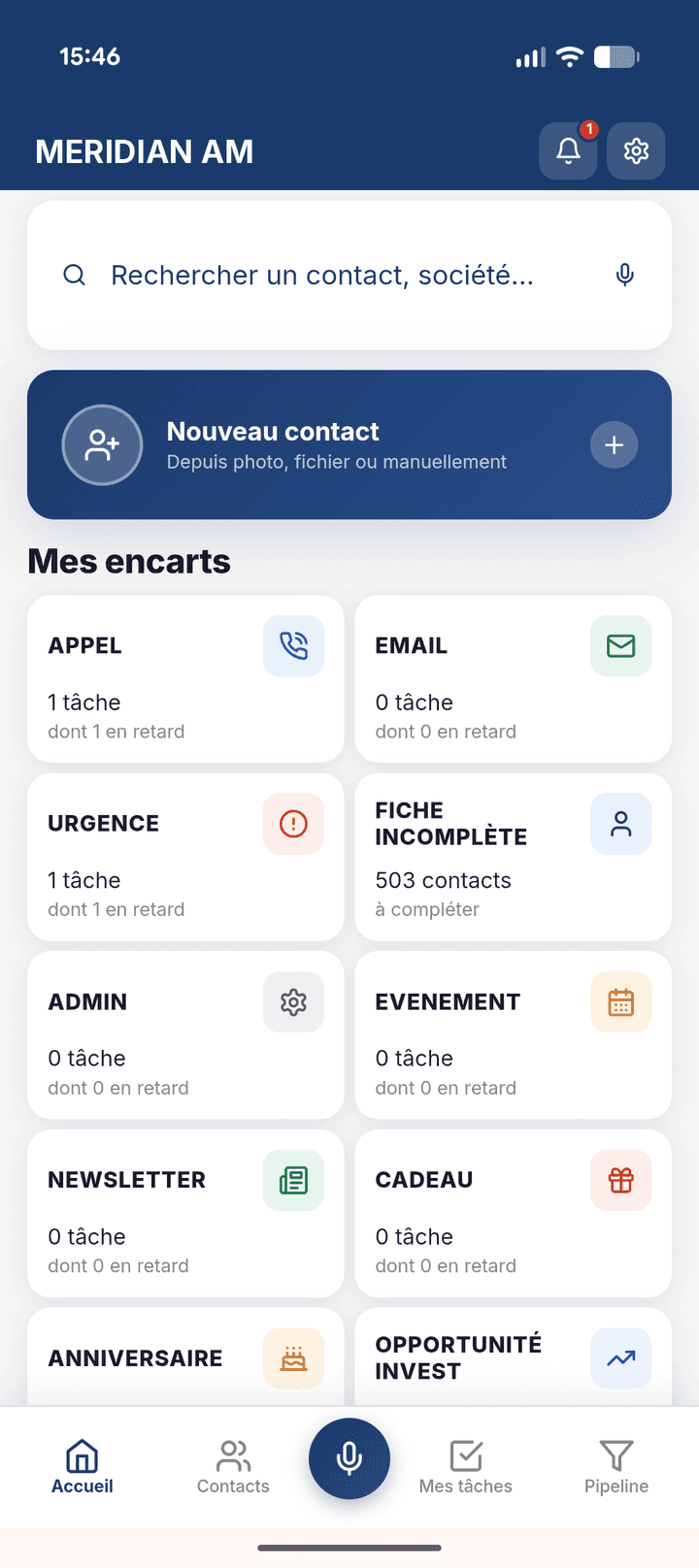
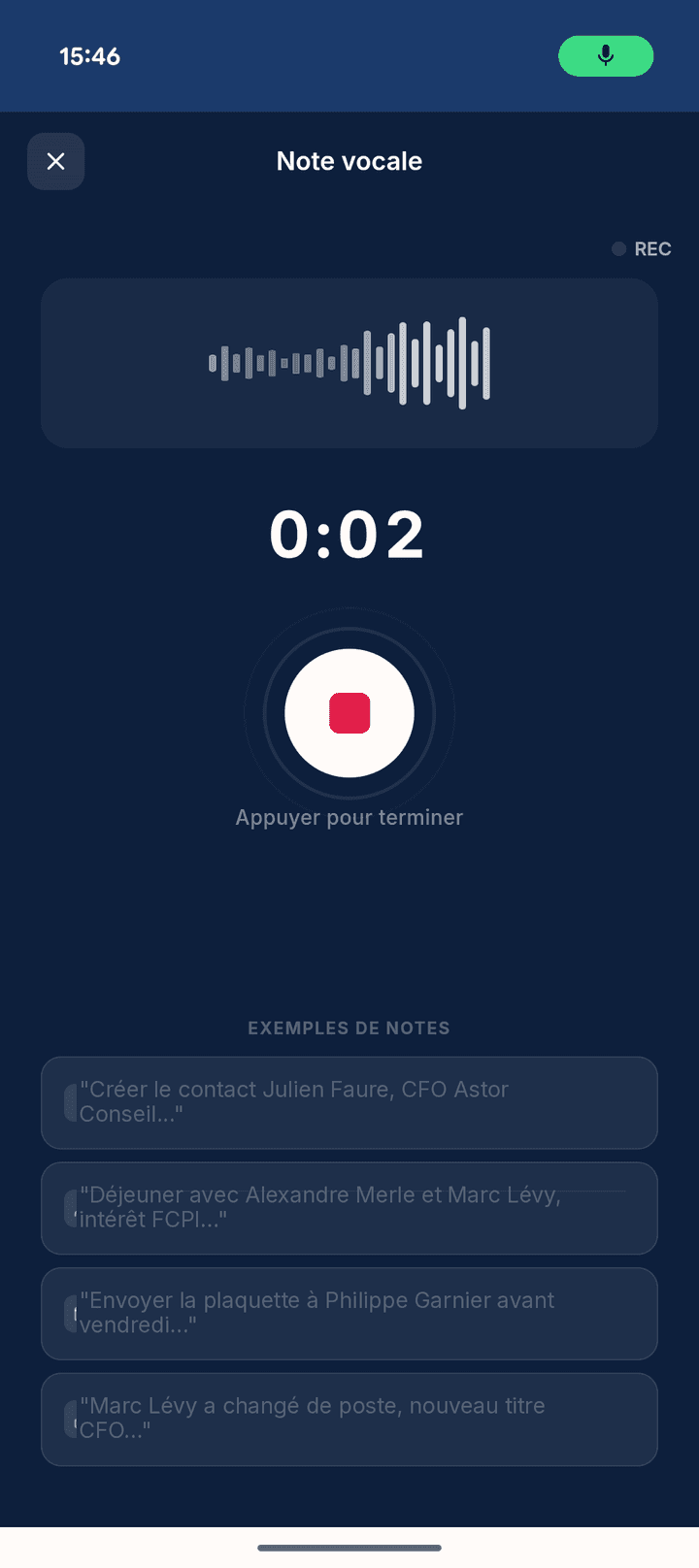
Capture & voice note
Dictate a note on the way out of a meeting. AI transcribes it and extracts the contact, the task and the due date, automatically attached to the right record.
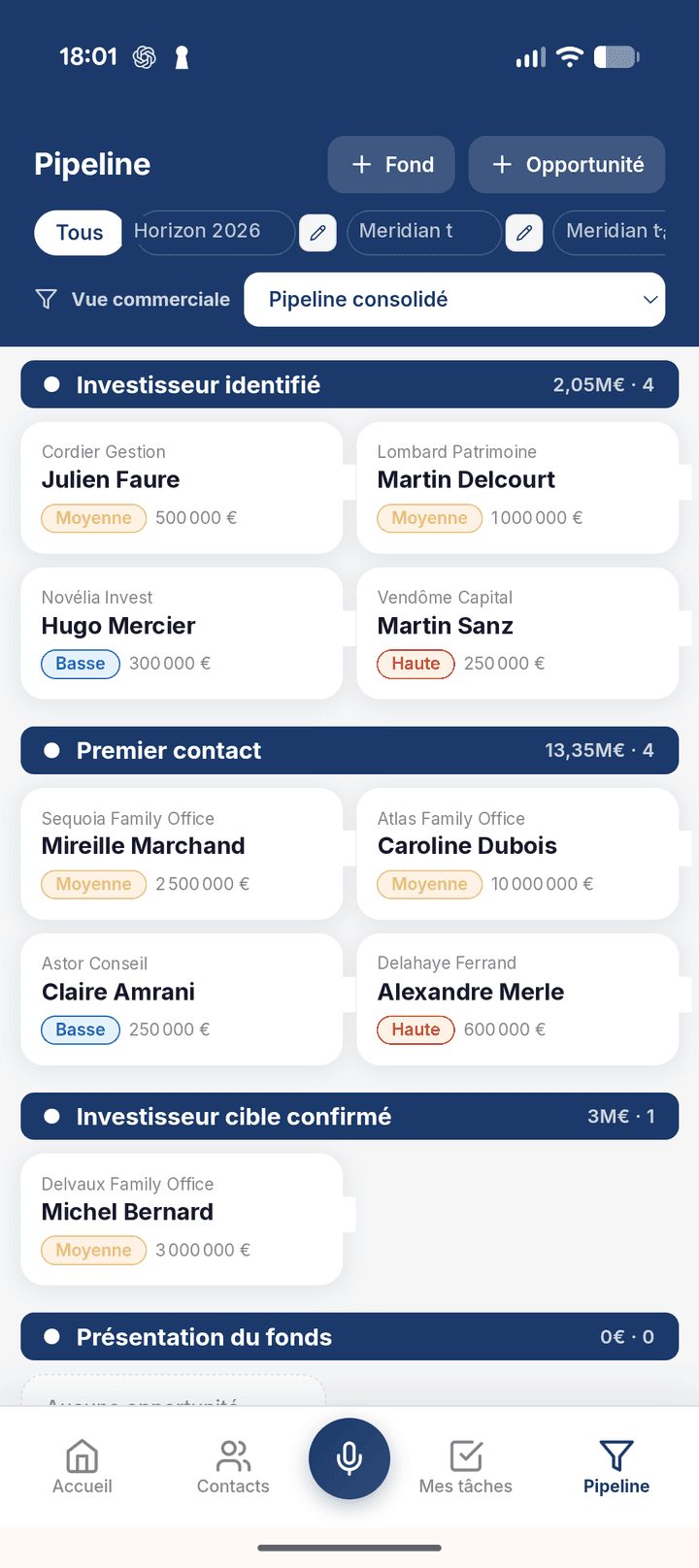
Visual pipeline by stage
Investor identified, first contact, target confirmed: each stage carries its amounts and priorities. The state of the raise fits on one screen.
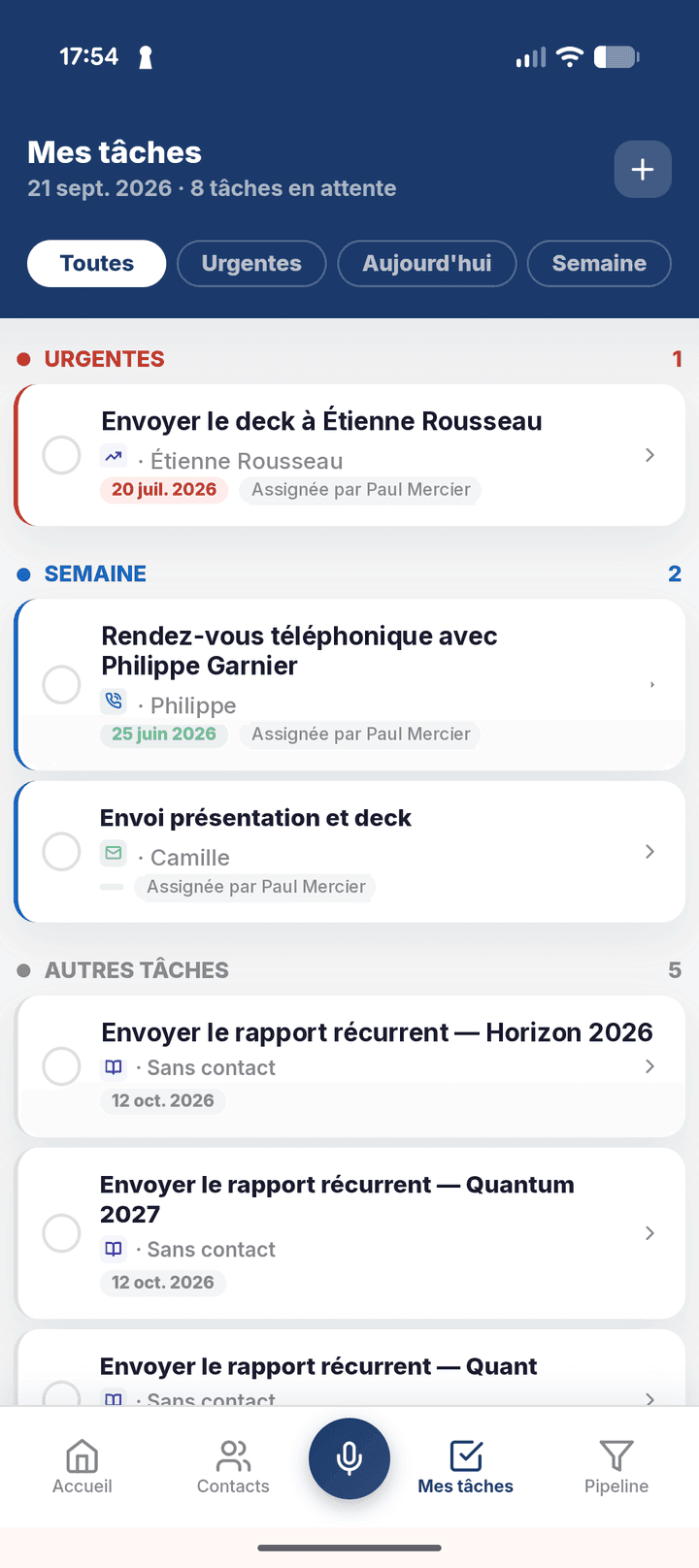
Tasks & follow-ups
Urgencies, due dates, assignment. What is overdue rises to the top; the rest waits its turn.
Enriched contact records
Titles, firms, prospect quality, interaction history. Search reaches the right contact in two taps, including away from the office.
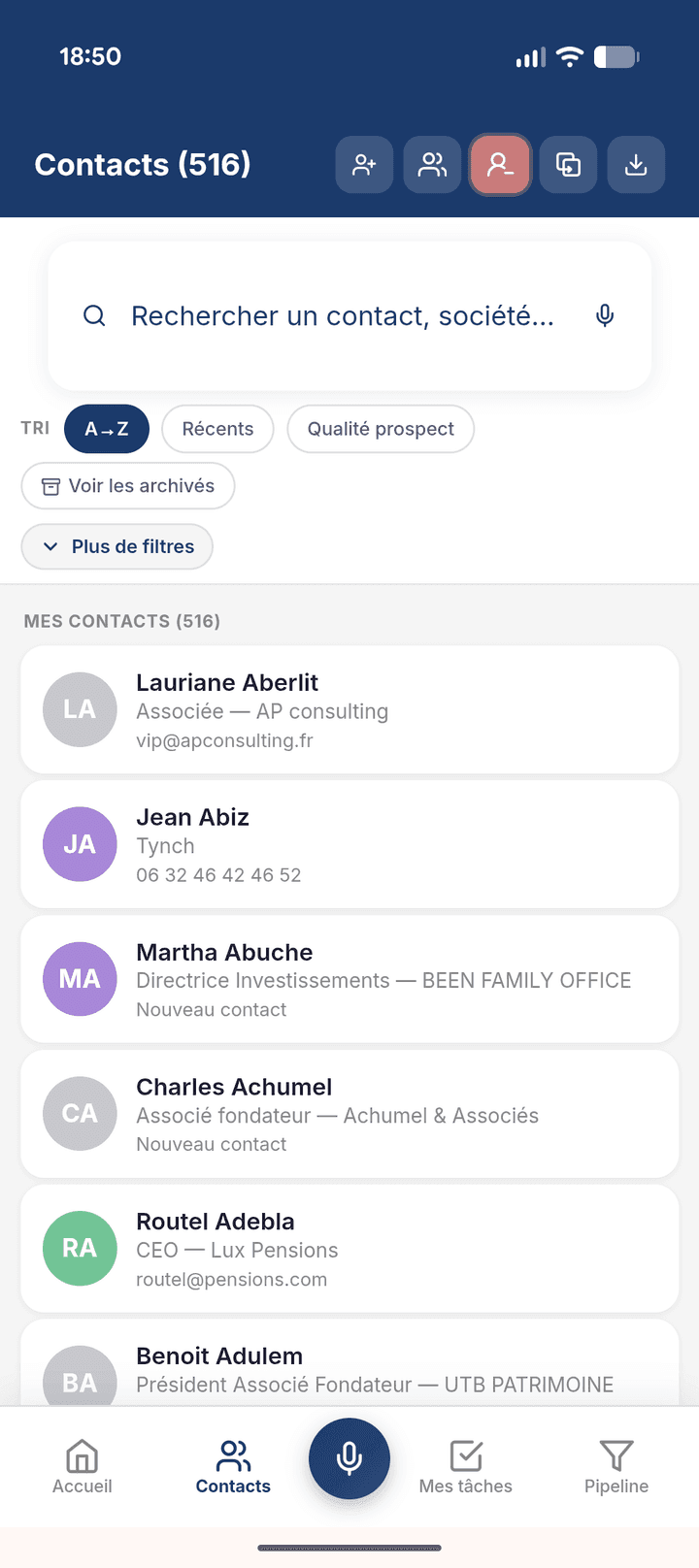
Screens from a demonstration environment. Fictional data.
Why a purpose-built product rather than an off-the-shelf CRM
A generic CRM can be configured; it cannot be bent onto a profession. The stages of a raise (investor identified, first contact, target confirmed) are not sales stages, and forcing them into a standard funnel produces a tool nobody fills in. So the choice was to build, starting from the real gesture: walk out of a meeting, dictate thirty seconds, move on.
- Mobile first: the work happens standing up, not sitting down. Desktop complements it, not the reverse.
- AI-powered voice transcription and structured extraction: the note becomes a contact, a task and a due date with no manual input.
- A pipeline modelled on the real stages of a raise, not on a generic sales funnel.
- Sovereign hosting and code ownership: the investor base is a strategic asset.
Put in the teams’ hands, not shipped and forgotten
The product was rolled out to the partners who do the raising, with existing data migrated and hands-on support. Success was not measured by launch but by adoption: a CRM nobody fills in is worth nothing, however good the engineering. The code, the infrastructure and the data belong to the client, and reversibility was designed in from the start.
3 months
from diagnosis to production
100% of the team
use the tool every day
10–15 min → a few seconds
of data entry after each meeting, replaced by a voice note
Three transferable lessons
Data is captured the moment it is said
Any system that requires deferred re-entry loses half the information. AI does not replace human capture; it removes the re-entry step that causes the loss.
A business workflow is not configured, it is redesigned
Forcing a fundraise into a standard sales funnel produces a tool people work around. Starting from the real stages costs more upfront and far less afterwards.
Adoption is the only metric that matters at the start
Before measuring a gain, the tool has to be used. A successful rollout is judged on observed usage, not on going live.
Sovereignty, ownership, reversibility
Let's start with a single workflow
The entry point is simple, bounded, and you walk away with something useful either way.
You pick a workflow that costs you time or margin.
Within a few weeks, we diagnose it with your teams.
You leave with a costed plan and a first proof of value.
Whether you take it further or not.